acc. PHILLIPS
  • acc. PHILLIPS
  • America
    • Introduction
      • Course Overview
      • Policies
      • Essential Documents
    • 1492-1754
      • Colonization
    • 1754-1848
      • Constitution
      • Expansion
    • 1848-1898
      • The Civil War
      • The Gilded Age
    • 1898-1945
      • The American Empire
      • The Great Depression
      • The Second World War
    • 1945-1991
      • The Early Cold War
      • The Great Society
      • The Late Cold War
    • 1991-Today
      • The Culture Wars
      • The War on Terror
  • Europe
    • Introduction
    • 1200-1450
    • 1450-1648
      • Renaissance
      • Reformation
      • Exploration
      • Readings
    • 1648-1815
      • Sovereignty
      • Commerce
      • Reason
      • Revolution
      • Readings
    • 1815-1914
      • Industry
      • Ideology
      • Empire
      • Modernity
      • Readings
    • 1914-Today
      • WWI
      • WWII
      • Cold War
      • EU
      • Readings
  • World
    • Modern
      • Introduction
        • Course Overview
        • Policies
        • Essential Documents
        • Exam
      • 1200-1450
        • Asia
        • Africa
        • Europe
        • Americas
        • Trade
      • 1450-1750
        • Discovery
        • Maritime Empires
        • Land Empires
      • 1750-1900
        • Revolutions
        • Industrialization
        • Imperialism
      • 1900-Today
        • World Wars
        • Postwar World
        • Globalization
  • Research
  • Resources
  • About
  • Contact
  • acc. PHILLIPS
  • America
    • Introduction
      • Course Overview
      • Policies
      • Essential Documents
    • 1492-1754
      • Colonization
    • 1754-1848
      • Constitution
      • Expansion
    • 1848-1898
      • The Civil War
      • The Gilded Age
    • 1898-1945
      • The American Empire
      • The Great Depression
      • The Second World War
    • 1945-1991
      • The Early Cold War
      • The Great Society
      • The Late Cold War
    • 1991-Today
      • The Culture Wars
      • The War on Terror
  • Europe
    • Introduction
    • 1200-1450
    • 1450-1648
      • Renaissance
      • Reformation
      • Exploration
      • Readings
    • 1648-1815
      • Sovereignty
      • Commerce
      • Reason
      • Revolution
      • Readings
    • 1815-1914
      • Industry
      • Ideology
      • Empire
      • Modernity
      • Readings
    • 1914-Today
      • WWI
      • WWII
      • Cold War
      • EU
      • Readings
  • World
    • Modern
      • Introduction
        • Course Overview
        • Policies
        • Essential Documents
        • Exam
      • 1200-1450
        • Asia
        • Africa
        • Europe
        • Americas
        • Trade
      • 1450-1750
        • Discovery
        • Maritime Empires
        • Land Empires
      • 1750-1900
        • Revolutions
        • Industrialization
        • Imperialism
      • 1900-Today
        • World Wars
        • Postwar World
        • Globalization
  • Research
  • Resources
  • About
  • Contact

Global Regions,
​c. 1200-1450

Africa

c. 1200-1450

African societies between c. 1200–1450 developed diverse regional states shaped by environmental conditions and connected through trans-Saharan and Indian Ocean trade networks, which facilitated economic growth, cultural exchange, and the spread of both Islamic and indigenous traditions.
Picture
Picture

Contents


Africa, c. 1200-1450:
  • Objectives
  • Maghrib & Ethiopia
  • Ghana & Benin
  • Mali & Songhai
  • The Swahili Coast
  • ​​Kongo & Great Zimbabwe
Picture

Objectives

return to top of page
  • ​​Explain how and why states in Africa developed and changed over time.
Picture
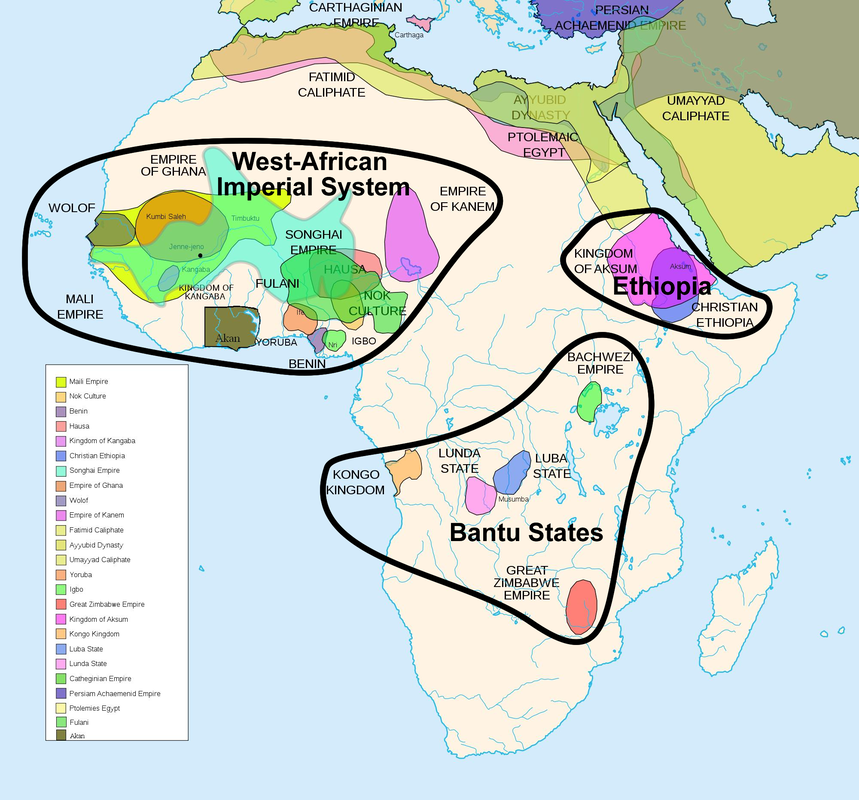
pre-colonial cultures of Africa (c. 500 BCE to 1500 CE)
​​In Africa, as in Eurasia and the Americas, state systems demonstrated continuity, innovation, and diversity and expanded in scope and reach.

Maghrib & Ethiopia
return to top of page
Compare Islamic North Africa with Christian Ethiopia as parallel religious and political systems.

Across northeastern Africa, the Maghrib and Ethiopia developed as parallel but distinct religious and political systems, each shaped by different faith traditions yet similarly structured around sacred authority and regional power. In North Africa, regions such as Ifriqiya and the broader Maghrib were integrated into the Islamic world, where dynasties like the Almohadis reinforced religious unity and political control through Islamic law and centralized rule. Authority was often justified through the defense and expansion of Islam, linking governance with broader transregional networks of trade and scholarship.

In contrast, the Ethiopian empire developed as a Christian kingdom rooted in Ethiopian Orthodox Christianity, maintaining continuity despite surrounding Islamic states. Under the Zagwe dynasty, monumental achievements like Lalibela—including the rock-hewn church of Bet Giorgis—symbolized both religious devotion and royal legitimacy. Later, the Solomonic dynasty drew authority from the Kebra Negast, which traced royal lineage to the biblical King Solomon, reinforcing sacred kingship. While North African Islamic states emphasized integration into a wider religious civilization, Ethiopia cultivated a distinct Christian identity tied to its own traditions. Despite these differences, both regions fused religion and governance, demonstrating how faith could anchor political authority in diverse but parallel ways.​
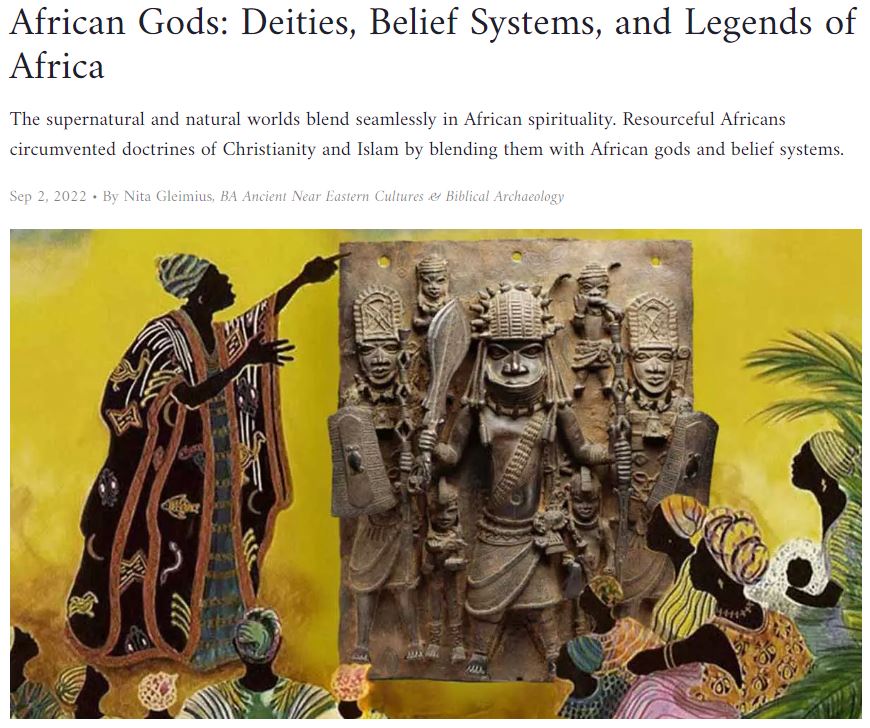
Article: African Gods: Deities, Belief Systems, and Legends of Africa
Picture
audio pronunciation guide:
  • Ifriqiya
  • Maghrib
  • Almohadis
  • Ethiopian empire
  • Zagwe dynasty
  • Lalibela
  • Bet Giorgis
  • Kebra Negast

​Ghana & Benin

return to top of page
Explain how forest and savanna states developed distinct political systems and artistic traditions.

Across West Africa, forest and savanna environments fostered distinct yet interconnected political systems and artistic traditions, as seen in Ghana and Benin. In the savanna, the Ghana Empire centered at Koumbi-Saleh developed a powerful, centralized state that controlled trans-Saharan trade routes, drawing wealth from gold and taxation. Its political structure emphasized kingship supported by administrative elites, while religious life often reflected Animism, integrating spiritual beliefs into governance and daily practice.

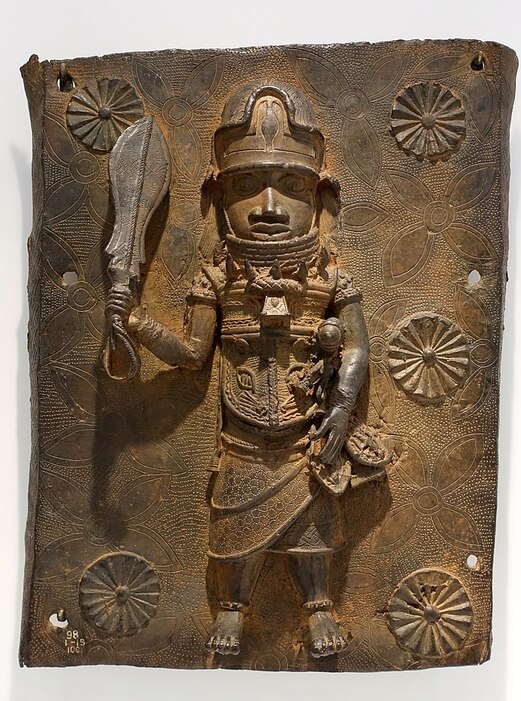
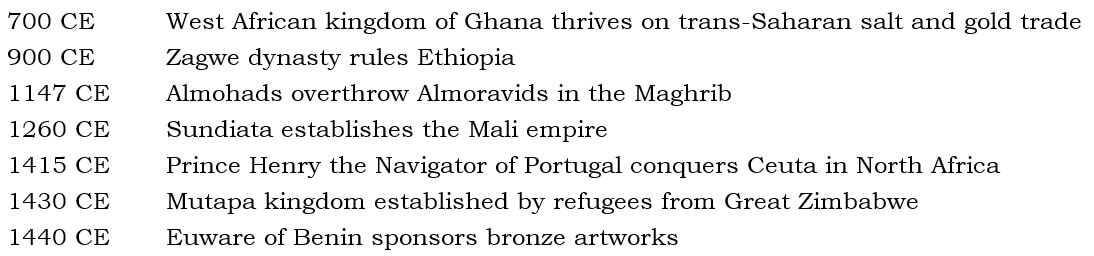
In the forest regions, states such as Benin and Yoruba polities like Ife and Oyo developed differently, emphasizing urban centers, ritual authority, and artistic expression. Under rulers like Ewuare, Benin became renowned for its sophisticated court culture and Benin bronze artworks, which depicted rulers, ceremonies, and cosmological themes with remarkable realism. Similarly, Yoruba centers such as Ife produced naturalistic sculptures that reflected both political hierarchy and spiritual significance. While savanna states prioritized long-distance trade and territorial control, forest states often emphasized cultural production and sacred kingship. Together, these regions illustrate how environment shaped governance and artistic achievement, producing diverse yet dynamic civilizations across West Africa.
audio pronunciation guide:
Ghana
  • traded gold and salt
  • Animism
  • Koumbi-Saleh

Benin
  • Ewuare
  • Bronze artwork
  • Yoruba
  • Ife
  • Oyo

Mali & Songhai

return to top of page
Picture
detail from the Catalan Atlas with Mansa Musa holding a massive gold nugget
Picture
Show how trade wealth supported powerful empires and centers of learning.

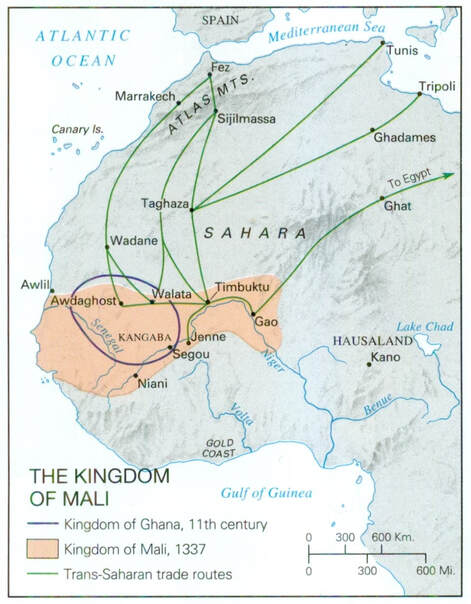
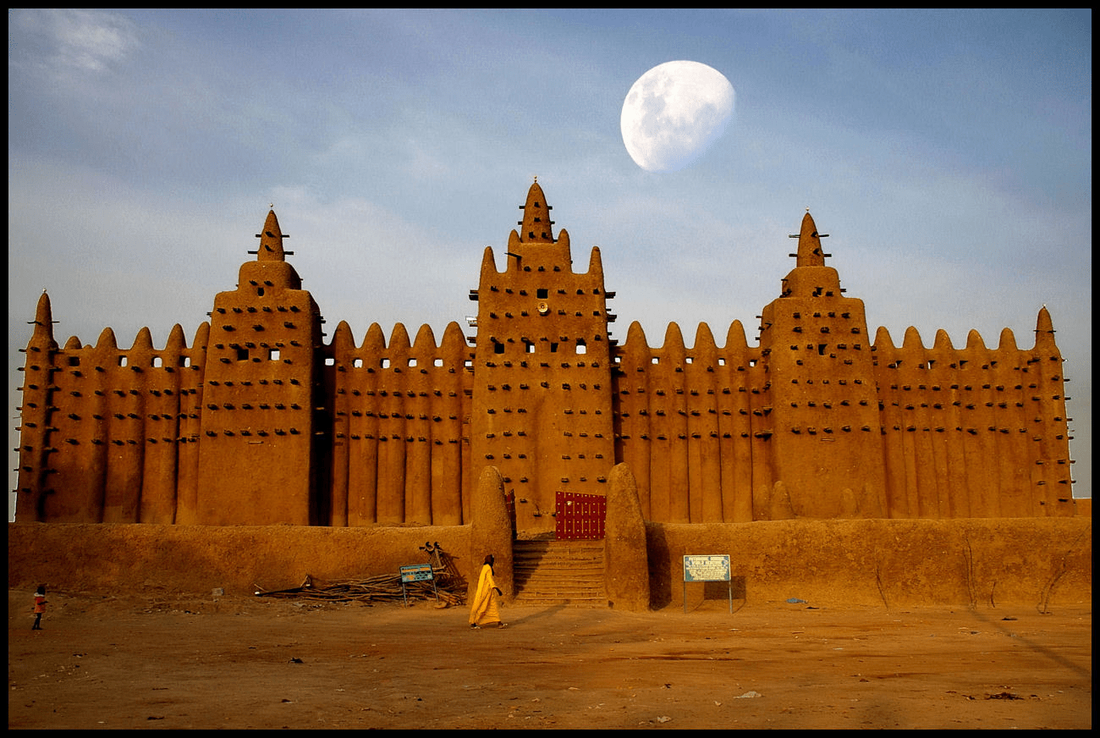
Across West Africa, the trans-Saharan trade network transformed regional kingdoms into powerful empires by channeling wealth through the gold-salt trade and extensive caravan trade routes. In Mali and Songhai, rulers leveraged this commerce to build centralized states and vibrant cultural centers. Sundiata established Mali’s political foundation, while Mansa Musa expanded its wealth and prestige, famously patronizing cities like Timbuktu and Jenne as hubs of commerce and Islamic scholarship. Travelers such as Ibn Battuta documented the region’s prosperity and intellectual life, while merchant networks like the Juula facilitated trade across vast distances. Oral historians known as griots preserved political and cultural memory, reinforcing social cohesion.

Songhai continued this legacy under leaders like Sunni Ali and Askia Muhammad, who expanded control over key cities such as Gao and strengthened Islamic institutions. Meanwhile, Hausa city-states thrived as commercial intermediaries. In this system, trade wealth did more than enrich rulers—it sustained armies, financed administration, and supported centers of learning, demonstrating how economic networks could underpin both political power and intellectual achievement.
Picture
University of Timbuktu
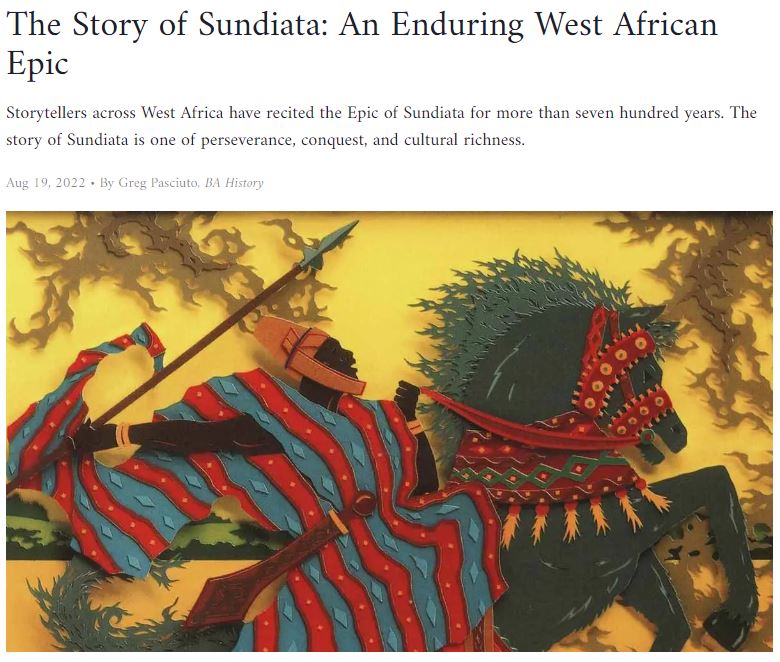
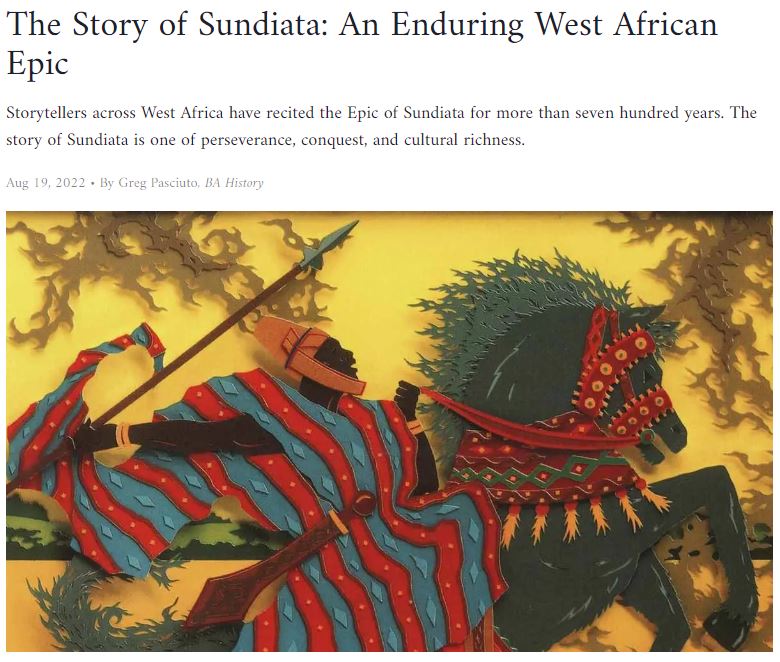
Article: The Story of Sundiata: An Enduring West African Epic
Picture
audio pronunciation guide:
  • Mali
    • Sundiata
    • Mansa Musa
    • ​Timbuktu
    • Jenne
    • Ibn Battuta
    • Juula
    • griots
  • Songhai​
    • Gao
    • Sunni Ali
    • Askia Muhammad
    • What allowed Moroccans to defeat the Songhai?
  • Hausa
​​​

The Swahili Coast

return to top of page
Explain how Indian Ocean trade created culturally blended coastal societies.

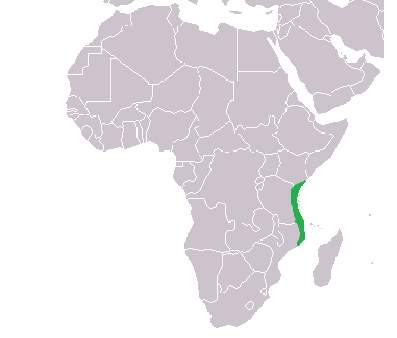
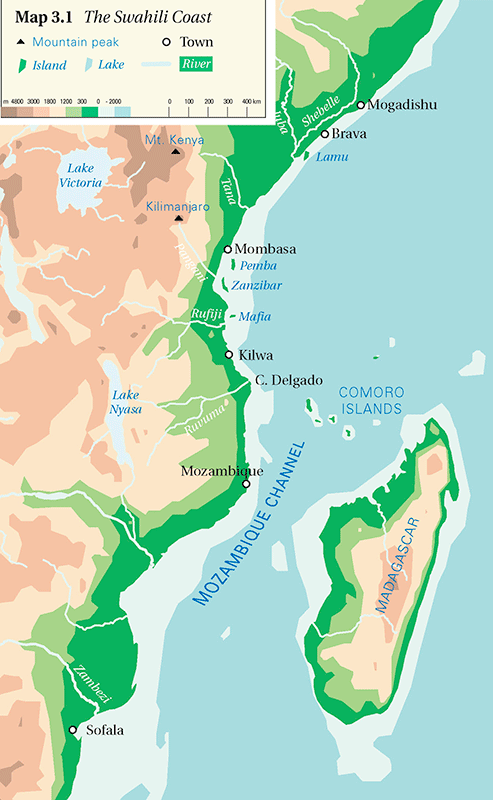
Along the Swahili Coast, the Indian Ocean trade network generated prosperous, cosmopolitan societies shaped by sustained contact among African, Arab, Persian, and South Asian peoples. Port cities such as Kilwa and Sofala flourished as commercial intermediaries, linking inland resources—especially gold from the African interior—to global markets. These cities drew wealth from trade and developed urban cultures that reflected both local traditions and foreign influences.

This interaction produced enduring cultural syncretism, most clearly seen in the Swahili language, a Bantu-based language infused with Arabic vocabulary and Islamic cultural elements. Islam spread gradually through merchant networks, blending with existing beliefs rather than displacing them entirely. At the same time, the Islamic slave trade connected coastal markets to the interior, where populations such as the Zanj were captured and sold. Resistance to this system, most notably the Zanj revolt in the Abbasid world, revealed the human cost embedded within these trade networks.

Despite these tensions, Swahili societies maintained a distinct identity, shaped by both African roots and global exchange. In this way, Indian Ocean commerce did more than move goods—it forged hybrid communities where language, religion, and social structures reflected centuries of interconnected interaction.
Picture
European depiction of Kilwa, c. 1572 CE
Picture
Picture
audio pronunciation guide:
  • Swahili language
  • Kilwa
  • Zanj
  • Islamic slave trade

​Kongo & Great Zimbabwe

return to top of page
Connect inland African states to broader trade networks and migration patterns.

Inland African states such as Kongo and Great Zimbabwe were deeply embedded in broader trade networks and long-term migration patterns, demonstrating that interior regions played a central role in Afro-Eurasian exchange. In southern Africa, Great Zimbabwe, built by the Shona people, controlled key trade routes that linked inland gold production to coastal markets, forming a vital Indian Ocean trade connection through Swahili intermediaries. Its political and economic power was symbolized by the massive Great Zimbabwe stone enclosure—an imposing complex of dry-stone walls that reflected both advanced architectural skill and the authority of its ruling elite. This wealth and influence later informed the rise of the Mutapa empire under Mutota, which expanded control over regional trade corridors.

Further west, the kingdom of Kongo, centered at Mbanza Kongo, developed as a centralized polity connected to regional and, eventually, Atlantic trade. These states were rooted in earlier demographic shifts, especially the Bantu migrations, which spread agricultural knowledge, ironworking, and language across sub-Saharan Africa. The broader Bantu cultural network facilitated exchange and cohesion across vast regions. In this way, migration and trade combined to elevate inland states as powerful connectors between local production and global commerce.
audio pronunciation guide:
  • Great Zimbabwe
    • Shona people

  • Mutapa empire
    • Mutota​
​
  • Kongo
    • Mbanza Kongo
    • Bantu
African Civilizations (comprehensive)
African Civilizations (abridged)
acc. PHILLIPS home
AP World: Modern home
1200-1450 CE: Global Regions
Asia
Africa
Europe
Americas
Trade
1450-1750
1750-1900
1900-Today

Select:

America
Europe
World

​

Resources:

Barron's AP European History Flashcards, Second Edition​

About:

Research
Meet Dave Phillips
Contact

​
This is a non-commercial website.
Contents are for educational purposes only.
© COPYRIGHT 2026.
  • acc. PHILLIPS
  • America
    • Introduction
      • Course Overview
      • Policies
      • Essential Documents
    • 1492-1754
      • Colonization
    • 1754-1848
      • Constitution
      • Expansion
    • 1848-1898
      • The Civil War
      • The Gilded Age
    • 1898-1945
      • The American Empire
      • The Great Depression
      • The Second World War
    • 1945-1991
      • The Early Cold War
      • The Great Society
      • The Late Cold War
    • 1991-Today
      • The Culture Wars
      • The War on Terror
  • Europe
    • Introduction
    • 1200-1450
    • 1450-1648
      • Renaissance
      • Reformation
      • Exploration
      • Readings
    • 1648-1815
      • Sovereignty
      • Commerce
      • Reason
      • Revolution
      • Readings
    • 1815-1914
      • Industry
      • Ideology
      • Empire
      • Modernity
      • Readings
    • 1914-Today
      • WWI
      • WWII
      • Cold War
      • EU
      • Readings
  • World
    • Modern
      • Introduction
        • Course Overview
        • Policies
        • Essential Documents
        • Exam
      • 1200-1450
        • Asia
        • Africa
        • Europe
        • Americas
        • Trade
      • 1450-1750
        • Discovery
        • Maritime Empires
        • Land Empires
      • 1750-1900
        • Revolutions
        • Industrialization
        • Imperialism
      • 1900-Today
        • World Wars
        • Postwar World
        • Globalization
  • Research
  • Resources
  • About
  • Contact